Why the land waits
Three years is not a waiting period — it's an argument about chemistry and biology

Organic certification does not begin at the moment a farmer stops spraying. It begins, formally, only when a certification body has accepted an application and issued a start date for what the rules call the conversion period — typically three years of land management to the required standard before a single kilogram of crop may carry the word organic. The interval is not bureaucratic caution dressed up as principle. It is grounded in the chemistry of synthetic residues and in the slower time-scales of soil biology, and understanding those two arguments is the clearest way to understand what an organic certificate is actually certifying.
The residue case is the more intuitive of the two. Many synthetic pesticides and some herbicides persist in soil for months or years after the last application. Organochlorines are the most stubborn — banned in most jurisdictions for decades, yet still detectable in some soils — but a range of organophosphates and fungicides also show measurable half-lives in field conditions. A crop grown on recently treated land absorbs residues through root uptake and through contact with contaminated soil particles; the fruit or leaf tissue then carries those residues into the supply chain. Residue sampling during and after conversion tests whether the file matches what is actually in the crop, but the conversion period is designed to allow time for concentrations to fall below the thresholds that would compromise the claim. Three years, repeated growing seasons, and the biological activity that breaks down organic compounds in healthy soil: together they work through the legacy of previous management.
The biology argument runs alongside and is, in some ways, more profound. Synthetic fertilisers, particularly soluble nitrogen compounds, progressively suppress the networks of mycorrhizal fungi and nitrogen-fixing bacteria that characterise undisturbed or organically managed soil. These organisms do not recover within a single season. Research on soil microbial recovery ↗ suggests the timescales involved are measured in years, not months, and that the full functional recovery of a soil community depends on what replaces synthetic inputs rather than merely on their withdrawal. Cover crops and green manures — legumes grown to be incorporated, supplying nitrogen through fixation rather than a bag — begin to rebuild the microbial ecology during conversion, but the ecology takes time to stabilise. A three-year minimum is a practical acknowledgement of that pace.
What the rules actually require during those three years
The conversion period is not passive. An operator in conversion must comply with the full organic standard from the day the period begins — the same prohibited inputs, the same record-keeping, the same traceability requirements that will apply once the certificate is live. What changes at the end of three years is not the management; it is the eligibility of the produce to be labelled and sold as organic. In some regulatory frameworks, produce grown in the second and third year of conversion may be marketed under a specific conversion label — the EU organic regulation, administered by the European Commission, permits this — but no year-one produce from converted land may carry any organic claim.
A certification body accredited under the IFOAM system, or one operating under a national programme such as the USDA National Organic Program ↗, will require an operator to submit a farm plan at application, updated annually. That plan includes field histories going back at least the length of the conversion period and ideally further. Inspectors at the annual audit will cross-check field records against purchase receipts for inputs, against sales records, and against the mass-balance calculation that reconciles the area under management with the volume of produce sold or in storage. Conversion land is fully visible in that audit trail from day one.
The start date of conversion may in some cases be back-dated — if an operator can demonstrate through credible third-party evidence that the land was managed to the required standard before the formal application. Satellite imagery of field-use patterns, municipal records, land-registry transactions, and records from an agricultural extension body have all been used to support back-dating claims. The certifier assesses that evidence and makes a decision; no credit is automatic. In Chiayi County, where smallholder plots on the slopes of the Alishan range sit within a landscape of mixed conventional and organic management, back-dating claims are complicated by the buffer-zone question: a plot adjacent to a conventionally managed neighbour carries a drift risk that its file must account for throughout the conversion period, not only after certification.
Altitude, cloud, and conversion in the Alishan growing area
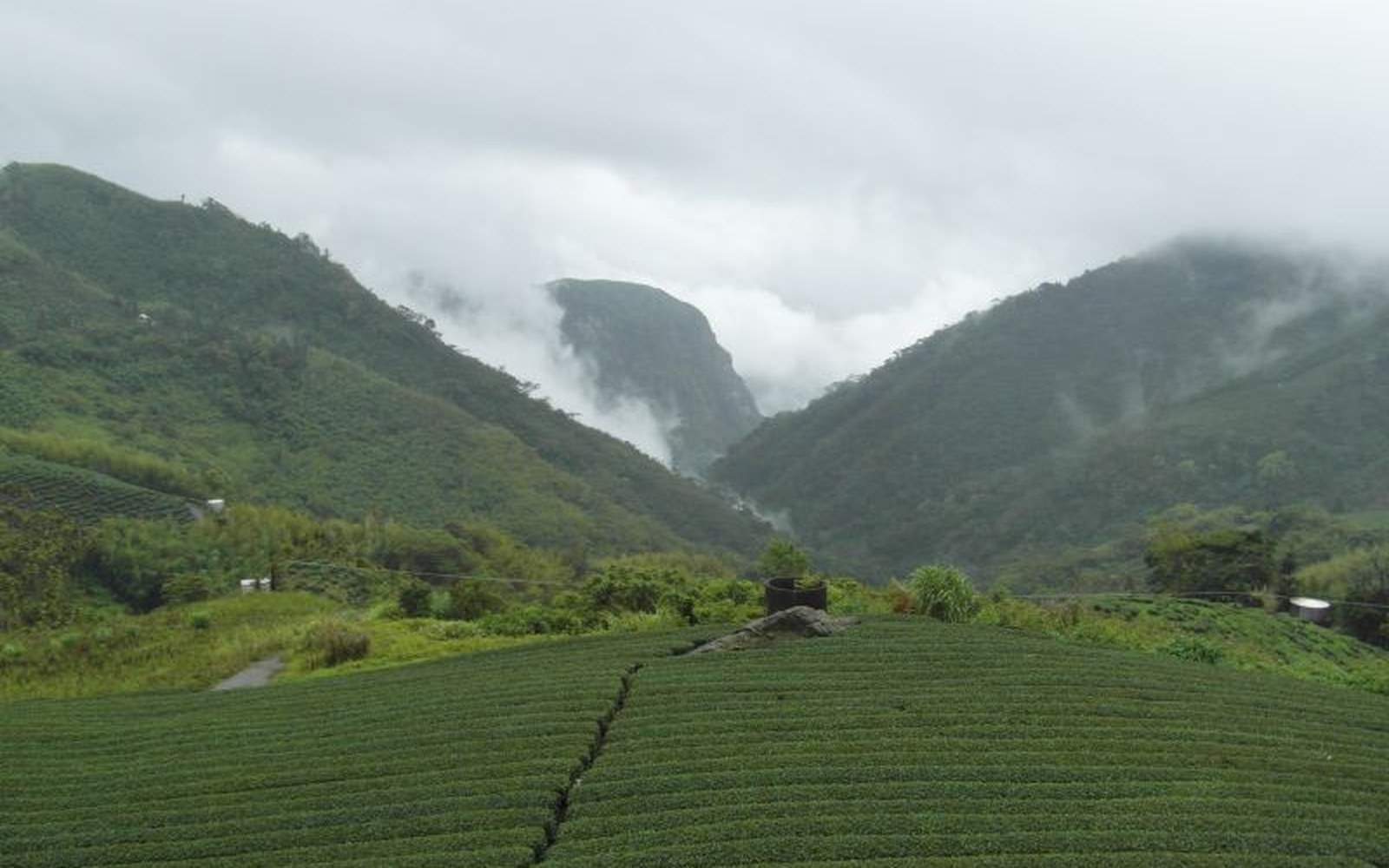
The specific conditions of high-altitude growing in the Alishan National Scenic Area add texture to the conversion argument. High-mountain oolong grown above roughly 1,000 metres on the slopes around Alishan matures more slowly than lowland tea: the daily cloud belt cuts direct sun, temperatures drop sharply at night, and the combination produces a leaf with slower cell development and, its growers argue, greater aromatic complexity. That same biology means the soil is often shallower, the rainfall more variable, and the slope erosion risk higher than at lowland sites. Conversion on these plots requires particular care with soil management during the transitional years, because organic matter is more precious and harder to rebuild at altitude, and because the slow-release nitrogen that cover crops provide takes even longer to cycle in cooler soils.
Residue persistence in mountain soils is also influenced by temperature: cooler soils slow the microbial degradation of synthetic compounds, meaning three years in a cool, high-altitude plot may leave a less degraded residue profile than three years on a warmer lowland site. This is not a reason the rules extend conversion at altitude — no major regulatory framework currently does so — but it is a reason that residue testing of conversion-period crops from high-mountain sites carries real diagnostic weight and why conscientious certifiers pay attention to site-specific factors when interpreting the results.
The regional context matters for one further reason. Chiayi County's Alishan area has an agricultural identity built partly on the reputation of its tea and forestry heritage — a reputation that the forest railway, opened in 1912 primarily to extract old-growth timber, helped to construct by making the mountain accessible. That identity now includes a growing organic and traceable-production sector. Conversion is where that claim begins to be earned, and the three-year wait is the mechanism that prevents the word organic from being detached from its material basis. Understanding why the land waits is understanding what the certificate is worth.