A visit, a file, and a decision
What an annual inspection actually is

The certificate in the shop window does not last forever. Organic certification is not a one-time award granted after the conversion period ends; it is a conditional status renewed every year, and renewal depends on a structured inspection that looks at records, inputs, and the physical farm in that order of depth. Understanding what happens during that visit — and what happens between visits — is the difference between reading a label and reading it with any confidence.
The inspection begins before anyone arrives on the farm. A certification body — an accredited private organisation operating under the authority of a national or regional regulatory framework — assembles the previous year's file: the operator's self-declaration, input purchase records, harvest tallies, and any correspondence triggered by the last cycle. The inspector who arrives at the gate is not starting from scratch. They are testing whether the physical reality matches a paper trail that already exists.
Once on site, the inspector works through three overlapping layers. The first is records: input invoices cross-referenced against the permitted substance list, spray diaries checked for dates and quantities, seed purchase records verified against planting logs. The second is physical inspection: stored inputs, equipment used for spraying, any shared machinery that could carry prohibited-substance residue, and the state of buffer zones around the certified parcels. The third is traceability: a mass-balance check that asks whether the volume of certified crop sold is plausible given the area planted, the declared yield, and the harvest records. If a grower sold twice what the land could have produced, the arithmetic will not hold.

The unannounced visit and what it changes
Announced inspections have an obvious limitation: a prepared visit can be a managed visit. Most certification schemes address this by building unannounced visits into their audit cycle. The USDA National Organic Program ↗ requires that certification bodies conduct a minimum proportion of unannounced inspections each year, and the EU's organic regulation — Regulation (EU) 2018/848 — extends a similar requirement across all operators in the system. IFOAM – Organics International, the global standard-setting body whose norms underpin many national frameworks, places unannounced inspection among its core accreditation criteria.
The effect is structural rather than punitive. A grower who knows that any given morning could bring an inspector cannot manage two different regimes — one for inspected periods and one for the rest of the year. Input storage, equipment cleaning, and record-keeping have to be continuous because the trigger for a visit is not known in advance. In practice, the risk of an unannounced visit is what makes the announced one meaningful: the paper file the inspector arrives with was compiled under conditions that could have been interrupted at any point.
Residue testing sits alongside inspection as a parallel check. Soil and crop samples are taken — sometimes during the inspection, sometimes independently — and tested for prohibited substances. A detection does not automatically mean fraud; drift from a neighbouring farm, for instance, can deposit residue on certified land without any action by the operator. What a detection does is trigger an investigation that examines the operator's records, the likely drift pathway, and the buffer zone documentation. The outcome determines whether the certificate is suspended or maintained. The EU Joint Research Centre's work on sampling strategies for organic control ↗ makes clear that testing is designed as a risk-based complement to audit, not a replacement for it.
The decision at the end of the file
After the physical visit, the inspector writes a report. That report goes to a decision-maker within the certification body — typically a separate person from the inspector, so that the person who gathered the evidence is not the person who rules on it. The decision has four broad outcomes: renewal without conditions; renewal with minor corrective actions required before the next cycle; suspension pending resolution of a specific finding; or withdrawal, which cancels the certificate and triggers consequences through the supply chain. Most inspections result in the first outcome. The system is designed to catch problems early, not to function as a trap.
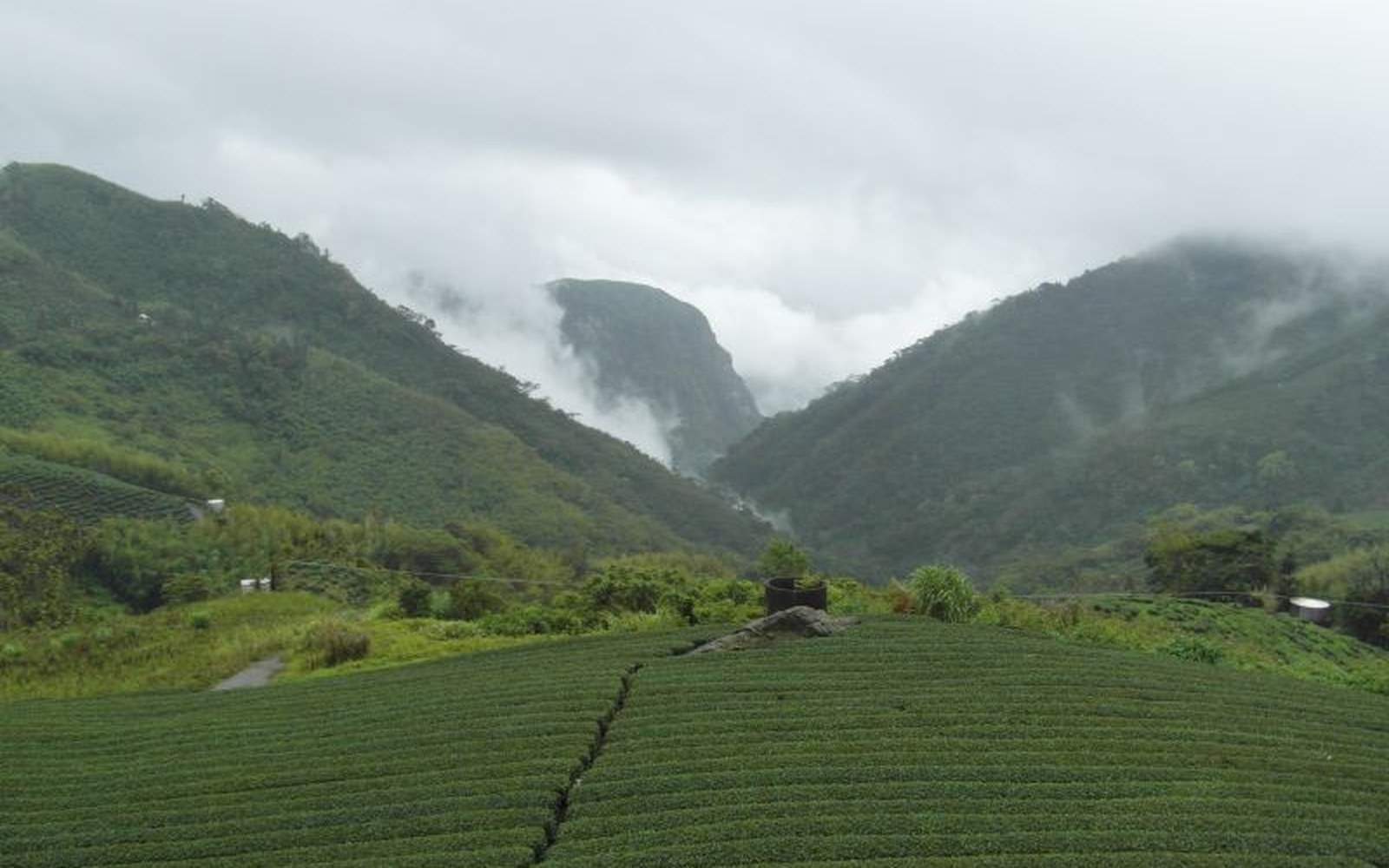
For a farm in the highlands of Chiayi County — where high-mountain oolong is grown above a thousand metres in the cloud belt that sits over the Alishan range — the inspection file carries a geography as well as an arithmetic. The inspector is working with parcels that may be steep, fragmented, and surrounded by conventionally managed land. Buffer zone documentation is not a formality in that context; the spatial relationship between a certified tea garden and its neighbours is a material question about whether the standard can actually be maintained on that piece of ground. The traceability check for tea is similarly specific: tea is processed before it is sold, and the processing step — withering, partial oxidation, rolling, drying — must itself be covered by the certificate or handled by a separately certified processor, with the chain of custody documented through each stage.
The file that comes out of an inspection cycle for a tea operation therefore covers more than a simple crop. It covers the growing parcel, any on-farm processing, transport to a licensed processor if processing is done off-farm, and the lot coding that allows a finished package to be traced back to a harvest date and a named parcel. Mass balance has to hold across all of those steps. An auditor who finds that the declared area of certified garden could not have yielded the volume of finished tea sold will ask for an explanation — and the explanation has to be documentary, not verbal.
The annual inspection is, in the end, a bureaucratic act, and that is not a criticism. The paperwork is the mechanism by which a standard written in a regulation becomes a verifiable claim on a label. The conversion period established that the land was managed correctly before the first certified crop came off it. The permitted substance list constrained what inputs were available throughout. The inspection confirms, once a year, that those constraints are still operating — and the possibility of an unannounced visit confirms it for every day in between. What the certificate certifies is not a philosophy or an intention. It certifies a file that passed a check.