Per hectare against per tonne
The unit you choose rewrites the answer
Organic farming generally does better for biodiversity, soil biology and greenhouse-gas emissions when those outcomes are measured against land area — but it generally does worse when they are measured against the weight of food produced. This is not a contradiction or a trick of presentation. It is a genuine methodological choice, and the choice changes the conclusion.
The reason is simple: organic yields are typically lower. A hectare of organically managed wheat in northern Europe might produce 20–25 percent less grain than a conventionally managed neighbour. If the environmental cost of that hectare — in carbon emissions, water drawn, energy expended — is roughly similar, then spreading it across fewer tonnes makes each tonne more expensive in environmental terms, even if the farm looks better on species counts and soil biology.
A 2012 meta-analysis in Nature led by Verena Seufert and colleagues found that organic yields were on average 25 percent lower than conventional ones, though the gap varied substantially by crop, system and region. That yield gap is the number that turns a per-hectare advantage into a per-tonne deficit.
Why both framings are honest, and what they measure
Per-hectare measurement asks: what does this land do? It is the natural unit for biodiversity, for soil carbon, for run-off and for the farm as an ecosystem. Insect abundance, earthworm counts and the width of wildflower margins are all area-based phenomena. Nitrogen lost to groundwater leaches from a field, not from a bag of flour.
Per-tonne measurement asks: what does feeding people cost? If a lower-yield system requires more land to produce the same quantity of food, the land-use penalty can offset biodiversity gains elsewhere. This is the displacement argument — lower yields potentially push production onto land that would otherwise not be farmed, which can cause more habitat loss than a high-yield system confined to less ground.
The displacement argument was developed rigorously by the Swedish researchers Stefan Wirsenius, Christel Cederberg and colleagues, and it complicates any simple claim that organic farming is automatically better for the environment. It depends on what happens at the margin: if uncultivated land is genuinely converted to compensate for lower yields, the per-tonne framing carries real weight.
Neither unit is wrong. They answer different questions. The problem arises when one is presented as the definitive verdict. A study reporting that organic systems emit fewer kilograms of carbon dioxide per hectare is truthful; a study reporting more kilograms per tonne of crop is also truthful. Reading both is not optional.
What the Alishan context adds
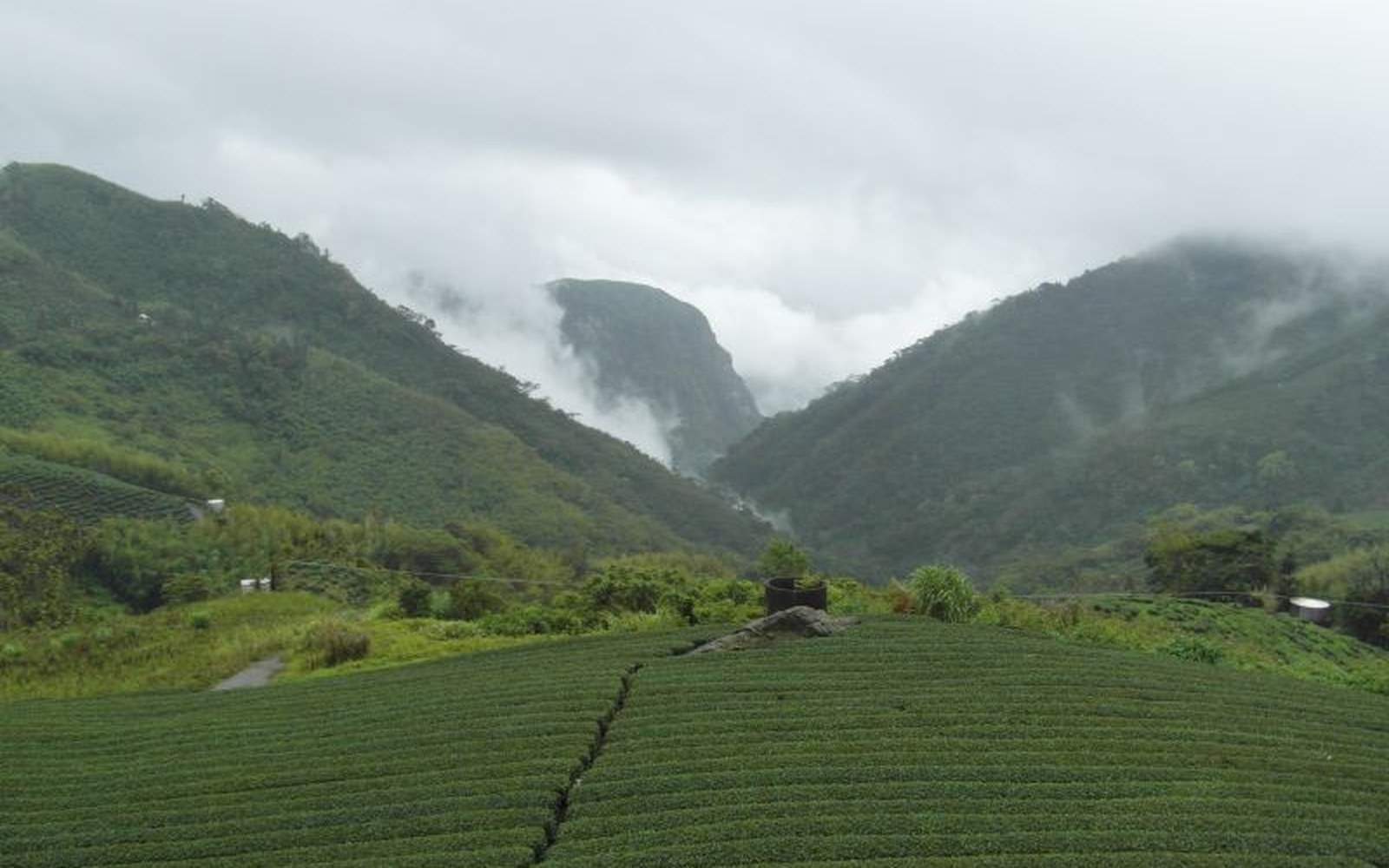
High-mountain oolong from Chiayi County is already a low-volume crop. The terraced gardens above 1,000 metres on the Alishan range are small, steep and labour-intensive; the yield gap between organic and conventional management, measured in dry leaf, is narrower than the gaps recorded in arable commodity crops. This matters because the per-tonne penalty partly traces its logic through large yield gaps. Where those gaps are smaller, the per-tonne and per-hectare framings converge.
Mountain tea gardens also exist in a landscape that is not going to be expanded to compensate for lower yields — the altitude, gradient and forest cover above the cloud belt impose limits that no commercial logic overrides. The displacement argument, potent for lowland cereals, applies with much less force here. The environmental case for certified organic production in this specific geography does not flip between framings in the way it does for wheat or soy.
A reader looking at an organic certificate on a packet of high-mountain oolong is looking at a label shaped by regulatory standards designed for a global system. The per-hectare versus per-tonne debate belongs, in its sharpest form, to the global system — to commodity crops, to global land budgets, to displacement at scale. On steep terraces in Chiayi County, the relevant numbers are different in magnitude, and the methodological warning still applies, but it bites less hard.
That does not settle the debate. It locates it. Wherever you read an environmental claim about organic farming, the first question is always the same: per hectare, or per tonne?